
The unwritten rules that shape teams: What Microsoft’s culture shift teaches leaders
When Satya Nadella became Microsoft’s CEO in 2014, he inherited a company with extraordinary technical talent and a reputation for fierce internal competition.
In a 2012 Vanity Fair investigation, journalist Kurt Eichenwald examined Microsoft’s controversial stack-ranking system, which assessed employees relative to their colleagues. Former employees described internal politics and an environment where helping someone else succeed could come at the expense of their own standing.
Microsoft had discontinued stack ranking before Nadella took over. But the habits people develop within a system don’t necessarily disappear when the system changes. That was part of the challenge facing Nadella: establishing a different understanding of what it meant to succeed at Microsoft.
What people learn from the system around them
Performance systems teach people more than how their work will be assessed. They also influence how colleagues interact and where people direct their efforts.
When individual achievement receives the strongest recognition, sharing credit can become less attractive. If expertise is associated with status, people may be reluctant to admit what they don’t know.
These expectations rarely need to be stated. Employees work them out by observing which behaviours bring recognition and which carry a risk. For Microsoft, moving beyond its reputation for internal competition meant giving people a different set of expectations to work towards.
From knowing the most to learning together
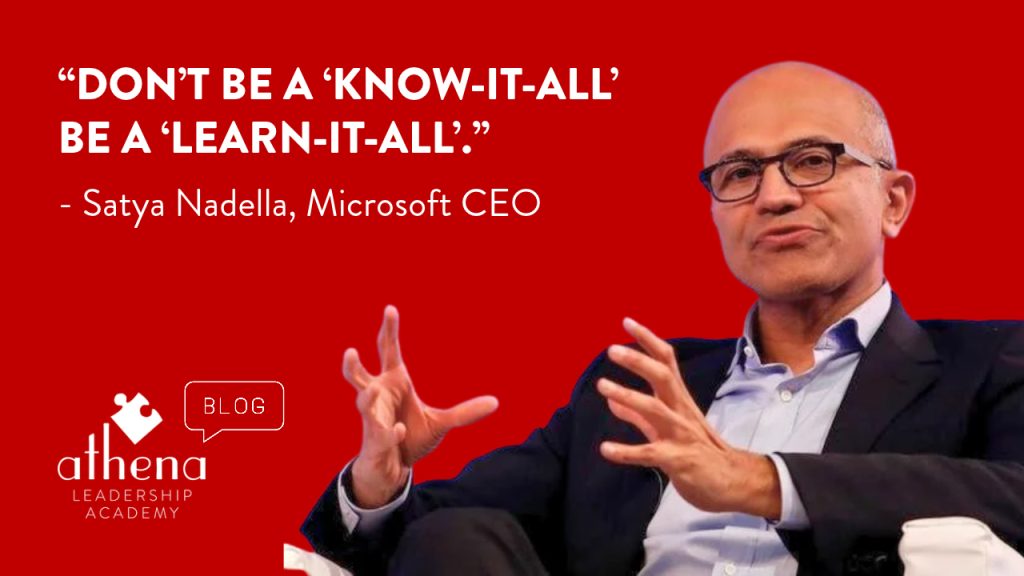
Nadella introduced a cultural ambition that became closely associated with his leadership: moving Microsoft from a “know-it-all” culture to a “learn-it-all” culture.
Drawing on psychologist Carol Dweck’s work on growth mindset, he encouraged greater curiosity, openness to learning and willingness to draw on other people’s knowledge. The language gave employees a way to recognise and discuss behaviours that could support a more collaborative organisation.
Microsoft also had to consider whether its management practices supported those expectations.
Changing what counts as success
An important part of Microsoft’s cultural transformation involved how employee contributions were understood and assessed.
The company’s approach to performance came to place greater emphasis on impact, including how employees contributed to the success of others and built on work taking place elsewhere in the organisation. Helping a colleague or strengthening another team’s work could be recognised as part of an individual’s contribution.
This matters because people pay close attention to how performance is assessed. They notice who receives opportunities, whose work is acknowledged and which behaviours leaders are willing to reward.
Microsoft’s approach provides a useful example of aligning cultural expectations with the decisions that influence everyday behaviour.
The rules nobody remembers agreeing to
Every team develops habits that influence how people work together. Some help, such as sharing ideas early enough for others to contribute. Others make collaboration harder, particularly when people become reluctant to challenge decisions or feel they need approval for every step.
These expectations take shape through everyday interactions. How a leader responds to a question, disagreement or suggestion tells people what is welcome and what is best avoided.
Eventually, certain behaviours become so familiar that nobody thinks to question them. A team can continue following an informal rule long after the circumstances that created it have changed. That’s what makes these expectations worth examining. They may be influencing decisions and relationships without anyone consciously choosing to maintain them.
Making the unwritten rules visible
One useful starting point is to ask team members what they’ve learned about how things get done. Who needs to be consulted before a decision moves forward? What happens when someone disagrees with a manager? Which contributions are noticed, and which tend to go unrecognised?
The answers can reveal assumptions that wouldn’t necessarily appear in a conversation about organisational values.
Leaders can then look for differences between what the team says it values and what its working practices encourage. A team may value initiative while requiring approval for relatively minor decisions. It may encourage collaboration while recognising only individual achievements.
These inconsistencies give leaders something specific to address. They can reconsider approval processes, change how contributions are recognised or make more room for different perspectives in team discussions.
It’s also worth examining their own responses. A leader who encourages people to challenge ideas needs to demonstrate that those contributions are genuinely welcome when they occur.
What have people learned about succeeding here?
Microsoft’s experience illustrates how much influence performance expectations can have on the way people work together. Its transformation took place on a scale few organisations will encounter, but the underlying question applies to any leadership team.
What have people learned they need to do to succeed here?
The answer may be quite different from what appears in the organisation’s values or leadership framework.
People might describe the importance of keeping senior colleagues informed, avoiding disagreement in meetings or taking on extra work to demonstrate commitment. Others may point to habits that make collaboration easier and deserve to be protected.
Listening to those answers gives leaders a clearer picture of the culture their teams actually experience. It also gives them a practical starting point for deciding which expectations they want to reinforce and which ones need to change.